Case Study
Mori Seiki NT4300 mill-turn center
→ Spain
This project shows how a Mori Seiki NT4300 was sold to the Spanish aerospace industry and delivered door-to-door — not as an ad-hoc phone deal but via MBR'sinternational partner network, with a clear line of responsibility from qualification through to on-site handover.
Machine
Mori Seiki NT4300
Destination
Spain
Industry
Aerospace (ES)
MBR role
Qualification, documentation, project lead
1. Starting point and target
The Spanish end customer from the aerospace industry needed a compact, highly integrated turn-mill solution for complex workpieces with tight tolerances. The Mori Seiki NT4300 met the technical constraints (envelope, spindle concept, tooling system) and was available on the market — the challenge sat in the cross-border execution: from technical qualification through contract logic to schedule-securedoor-to-door delivery at the Spanish site.
MBR was engaged because we don't run such corridors "ad hoc" via anonymous marketplaces but with fixed partners in sourcing, inspection and transport. The customer should know at any time who is responsible for which sub-task — and who carries overall responsibility.
2. Why a partner network — and still only one MBR contact
High-value used machines rarely move linearly from A to B: there are seller sites, possible intermediate storage, hauliers with special permits and, within the EU, varying customs and VAT scenarios. This is exactly where MBR's partner network sits: qualified contacts for technical double-checks, regional logistics partners and documentation-experienced back-office partners.
The decisive point: the end customer in Spain communicates directly with MBR — we bundle information, avoid handovers, hold the schedule together. A chain of sub-tasks becomes one project with one responsible head.
3. Qualification and technical release
Before any purchase, MBR runs a structured qualification: condition of main assemblies, controller access, documented run times, visible wear, and — depending on machine — spot-tests on critical functions (spindle, turret, axis behaviour). The result is a traceable inspection report the buyer has before final decision.
For the NT4300: acceptance criteria aligned with the Spanish user, technical data cross-checked on site, and transparent communication on every finding — no embellishment, no marketing language.
4. Contract, payment flow and documentation
In EU trade, correct commercial invoices, packing lists and (where applicable) movement certificates are decisive — not only for customs, but also for later depreciation and operating liability. MBR drafts these documents to match the real machine configuration (serial numbers, equipment, weight, dimensions).
In parallel, delivery terms and handover points were defined: where does seller responsibility end, where does transport insurance begin, who coordinates unloading at the Spanish site? These points were agreed in writing in advance — not when the low-loader is at the gate.
5. Logistics within the EU
Even within the EU, machine transport is not standard parcel work: axis securing, load securing, crane capacity and hall access have to match. MBR coordinated loading and transport with specialised partners and prepared the handover at the Spanish project site.
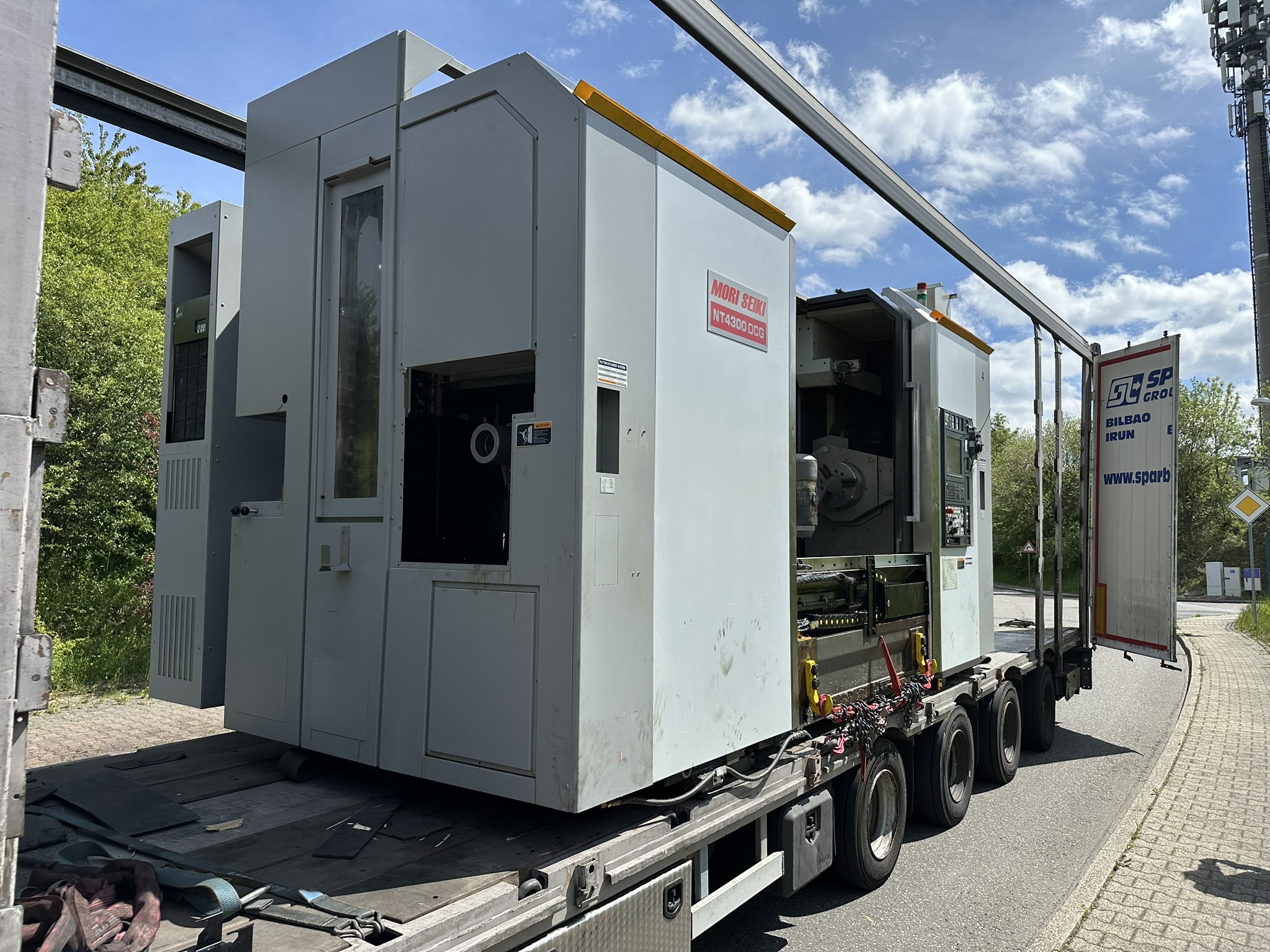
The project photo of the NT4300 in Spain documents exactly that moment: the machine at the point of value creation — technically released, logistically complete, ready for integration.
6. Result
The machine was sold to Spain and delivered via MBR's international partner network — with end-to-end documentation, clear project leadership, and a handover traceable at the Spanish site. That is the core of this reference project.